
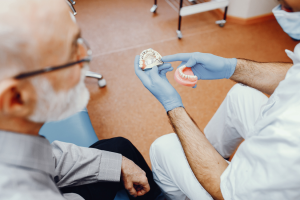
If you’re considering getting dentures to replace your missing teeth, you probably have questions about what the process looks like—as well as what to expect along the way. You should know that modern dentures are more comfortable, natural-looking, and functional than ever before! That said, whether you opt for traditional dentures or a solution that’s supported with dental implants, you’ll have to go through some key steps. Here’s a closer look.
1. Your Comprehensive Consultation
Every denture journey begins with a detailed examination of your smile and a discussion about your dental health and your goals. During this visit, your dentist will evaluate your oral health, take X-rays or 3D scans, and make sure that dentures are a good option for you. Some patients might be recommended implant-supported dentures for added long-term benefits, but they need to have enough jawbone density to support the posts.
2. Choosing Your Dentures
There are several different types of dentures available. Full dentures can be used to replace entire arches or lost teeth, while partial dentures are ideal when only some of the teeth are missing. Dentures are also categorized as traditional, which means they’re supported with suction and adhesives, or implant-retained, meaning they’re attached to dental implant posts that are surgically placed into the jaw.
3. Impressions & Preliminary Procedures
Once your treatment plan is finalized, impressions are taken of your mouth, which are used to create dentures that fit comfortably, align properly with your bite, and look completely natural while complementing your facial features. In some cases, patients may need to undergo preliminary treatments before they can receive their dentures, like gum disease treatment or tooth extractions.
4. Placement Day
Your dentures are made to your specific standards, and it can take a couple of weeks for your final restoration to be created. If you’re receiving implant-retained dentures, you’ll have to undergo oral surgery and a recovery period so that the posts can integrate with your jaw to serve as support for the dentures. Once everything is healed up and your dentures are ready, they can be placed!
5. Adjusting to Your New Smile
It’s completely normal to need minor adjustments after you first receive your dentures, and you may notice mild soreness, increased saliva production, and changes in chewing and speech. You should adjust to wearing your dentures after a few weeks, but if anything ever seems off, don’t hesitate to let your dentist know. With the right care, your dentures can serve you well for many years before a reline or replacement is needed!
While the timeline may vary from several weeks to a few months, your dentist will always let you know what to expect—and you should already know that the wait is well worth it, given all the benefits of having a complete smile!
About the Practice
Our team here at Worcester Dental Arts has proudly served patients in the area for several years under the leadership of Dr. Shadi Haidar and Dr. Krupali Shah. We offer a wide range of services, including routine preventive care, smile-enhancing cosmetic dentistry, and numerous restorative options, including both full and partial dentures, as well as dental implants. If you have any questions about the blog or you need to schedule an appointment at our Worcester office, please call or visit us online for more information or assistance. Telephone: (508) 793-2114.